Once you apply for a mortgage, whether for a purchase or a refinance, you’ll soon get your fair share of paperwork. There are things to sign, initial and understand and some of those documents might seem a bit redundant, if not confusing. Yet by law, these loan disclosures are required to be presented to those who apply for a home loan to provide a thorough understanding of the terms of the loan, monthly payments and other important information. One document included in the stack is a form generally referred to as an Interest Rate Lock/Float Agreement. Why is this included?
Because your interest rate isn’t guaranteed until you specifically request the lender lock your rate for you. Here’s why that’s important. You recall when you first started out researching mortgage options, one of the most important things you wanted to know concerned interest rates. What’s the rate today? Are there any points? What’s my monthly payment? All questions revolve around the interest rate. Yet regardless of any rate you see advertised or quoted to you directly, they’re really not available to you. You need to lock that rate in.
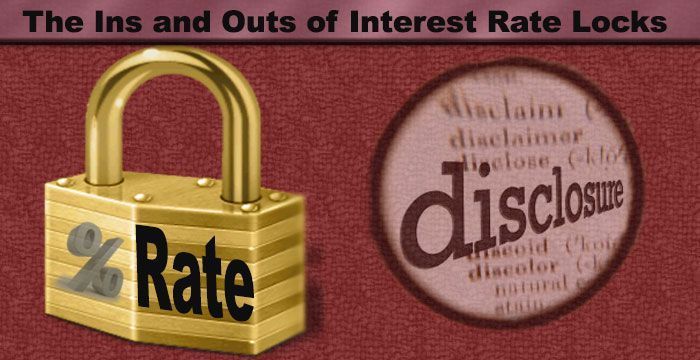
Lenders can have different rate lock policies but whatever the policy it must be disclosed. That disclosure comes in the form of the Rate Lock/Float Agreement. One of the primary requirements to lock in a rate is having a loan application on file with the lender. Many years ago, potential borrowers could call up a few lenders and lock in an interest rate over the phone and think about applying for that loan later on. That option didn’t really last very long and only a few lenders played that game. Why? Because lenders take interest rate locks just as seriously as you do. Expired interest rate locks can cost lenders some serious money. That said, what can you expect with an interest rate lock?
The longer the rate lock request, the more expensive the loan will be. A typical lock is usually 60 days, enough time to close on a purchase agreement. If you need a longer term lock, say 75 or 90 days, a lender will add a small fee to extend the rate for the longer term. A 45 day lock will be a tad lower than a 60 day, for example.
With an application on file, lenders can accept a rate lock but may have a few more milestones. You may have an application on file but if it’s not complete, you may not be in a position to lock. You’ll need to have a property for instance. Your lender will need to pull a credit report. Higher scores can lower a rate. If your loan lacks documentation, a lender may not accept a lock until requested items are provided. Again, different lenders may have slightly different requirements but they all need a completed, documented application.
What happens if the interest rate lock expires before your loan closes? If the delay was beyond your control the lender can typically accommodate a rate lock extension without a cost to you. However, if your rate lock expired because you didn’t provide the documentation on time or there were other items discovered that negated your lock, lenders will offer either a prevailing rate or renew the locked rate, whichever is higher. Change properties? Deal falls through? The rate lock may be subject to an immediate expiration.
The bottom line with interest rate locks asks that both the lender as well as the borrower act in good faith to close the loan on time. When the lender asks for more documentation from you, say an extra pay check stub or answer a query about a tax return, promptly respond. At the same time, you should expect your lender to work as efficiently as possible to make sure your closing papers arrive when they’re supposed to. If the Rate Lock Agreement isn’t very clear to you, make sure you talk to your loan officer before you get too far into the process.